
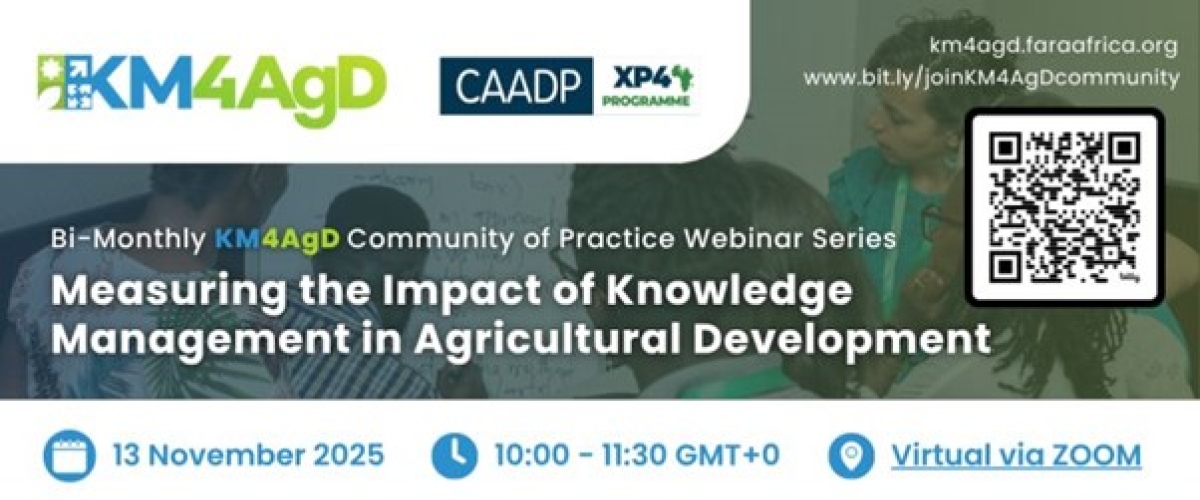
The KM4AgD Community of Practice, under the CAADP-XP4 Programme, convened its fourth bi-monthly webinar on 13 November 2025, bringing together a diverse audience of agricultural researchers, policymakers, development partners, and knowledge management practitioners from across the continent. Hosted under the theme “Measuring the Impact of Knowledge Management in Agricultural Development,” the session provided a rich platform for sharing practical experiences, methodologies, and lessons that demonstrate how KM contributes to organisational effectiveness and agricultural transformation.
During his welcome, Mr. Benjamin Abugri, FARA Knowledge Management Cluster Lead, emphasized that the KM4AgD platform continues to provide a continental space where practitioners learn together, challenge one another intellectually, and co-develop tools and practices that strengthen Africa’s AR4D landscape. He noted that this webinar was particularly timely as institutions across the continent are under growing pressure to showcase the return on KM investments.
The meeting opened with remarks from the moderation team, Elizabeth Asiimwe, Mabel Lum Shu, and Bebel Nguepi, who underscored the growing recognition that KM must go beyond storing information. Institutions are increasingly expected to demonstrate how KM investments translate into improved decision-making, strengthened programmes, and policy influence. With this framing, the presenters offered insights from research institutions, regional bodies, and development partners, collectively painting a multi-layered picture of how KM impact is measured across Africa’s Agricultural Research for Development (AR4D) systems.
Adding to this framing, Professor Fatunbi Oluwole, the Acting Research and Innovation Director from FARA, delivered reflective opening remarks that set the tone for the discussions. He reaffirmed FARA’s commitment to strengthening KM capacities across the continent and emphasised that KM is not simply about collecting information but about “transforming knowledge into action.” Prof. Oluwole noted that African institutions increasingly recognise KM as a catalyst for innovation, collaboration, and accountability, and he commended the KM4AgD CoP for providing a learning space where institutions can collectively build the evidence base for KM impact. His remarks underscored the critical role that CAADP-XP4 partners continue to play in harmonising KM practices and building a shared culture of learning within the AR4D ecosystem.
With this strong conceptual foundation, the webinar transitioned into presentations that offered practical, evidence-based insights from research institutions, regional networks, and development partners
The first presentation, delivered by Simone Staiger Rivas of the Alliance of Bioversity & CIAT (CGIAR), emphasised the centrality of KM in accelerating the uptake of research innovations. She illustrated how CGIAR integrates KM into its research-to-impact pathways, using knowledge flow mapping, digital repositories, and robust MEL systems to track how scientific outputs travel from laboratories to farmers’ fields, policy tables, and innovation platforms. Simone highlighted that within large research programmes, KM impact becomes visible through improved accessibility of evidence, increased research adoption, and adaptations made by policymakers and implementers based on documented lessons. Her case demonstrated that effective KM not only disseminates research but also enhances learning loops that influence future research design and agricultural investments.
From a development partner perspective, the second presentation by Lisa Kircher, Senior Safeguards Specialist at the Asian Development Bank (ADB), offered a donor lens on the importance of KM for accountability and decision-making. She described how KM supports ADB’s safeguard processes by ensuring that lessons are documented, shared, and applied across projects. Lisa emphasized that KM strengthens transparency, informs risk mitigation, and guides project design and adaptation. She noted that development partners now place a high priority on measurable KM results, as they enable institutions to justify investments, improve implementation quality, and generate evidence to support future funding and partnerships. Her presentation reinforced the idea that KM is indispensable in ensuring development effectiveness.
The third case highlighted the CAADP-XP4 Programme, presented by Dr. Bridget Kakuwa-Kasongamulilo, CCARDESA’s Information, Communication, and Knowledge Management Manager. She showcased the CAADP-XP4 Programme’s KM-driven approach to strengthening the CAADP Malabo and Kampala sensitisation processes across seven SADC countries. Through a coordinated and well-structured KM strategy that included knowledge mapping, simplified policy messaging, multimedia content, and strengthened digital platforms, the sensitisation exercise brought the Malabo commitments closer to policymakers, researchers, media actors, and grassroots implementers. Dr. Kakuwa noted that the initiative significantly improved understanding of the Malabo Declaration, enhanced visibility for the process, and strengthened national capacities to monitor agricultural commitments. The use of the Africa KM Framework and the Continental MEL Strategy provided a structured approach to impact measurement, ensuring that outcomes such as policy uptake, enhanced awareness, and improved institutional collaboration could be demonstrated across the region.
Dr Kakuwa-Kasongamulilo also spotlighted the KM4AgD Challenge, an initiative that has trained and certified more than 70 KM champions from over 40 African countries. She noted that the Challenge has catalysed institutional transformation, created national communities of practice, and elevated young African KM professionals into leadership roles. The programme serves as a continental example of how structured KM capacity-building can yield measurable improvements in organisational learning, visibility, and strategic influence.
Across all cases, a shared narrative emerged: knowledge management is no longer a peripheral function; it is a strategic driver of agricultural transformation. Whether through making research accessible, simplifying policy frameworks, documenting development processes, or building structured MEL systems, KM is reshaping how institutions learn, collaborate, and deliver impact.
The final technical presentation was delivered by FARA’s Monitoring, Evaluation and Learning Specialist, Mr. Anselme Vodounhessi, who showcased the Continental MEL Strategy. His presentation of the MEL System illustrated how the strategy’s tools and portals provide a structured mechanism for monitoring KM performance and agricultural development outcomes across CAADP-XP4 institutions. He showed how the system enables real-time reporting, cross-institutional comparison, and systematic tracking of progress. The demonstration highlighted the growing shift from isolated reporting towards a continent-wide, harmonised MEL approach that supports institutional learning and strengthens evidence-based policymaking.
The session concluded with reflections from the moderators, who commended the presenters for offering concrete, evidence-based insights into a traditionally abstract field. They encouraged participants to continue applying the lessons learned and to strengthen collaboration within the Community of Practice. As Africa moves into a new phase of agricultural development prioritising learning, innovation, and accountability, the KM4AgD webinar reaffirmed that KM remains an essential ingredient for sustainable transformation.