
By Lonely Mandiwa Msowoya and Mark Ndipita
What began as a small group of passionate farmers in Northern Malawi has transformed into a thriving business that is sweetening both incomes and livelihoods. Euthini Bee keepers Cooperative, which is now proudly called Chamunya Cooperative, has become a shining example of how the Malawi Food Systems Resilience Program (MFSRP) is turning rural dreams into profitable realities.
Nestled under Euthini extension planning area in Mzimba North, about 365 kilometers north of Lilongwe, the capital city of Malawi, the cooperative now boasts an impressive 650 beehives, 500 of which were acquired through MFSRP’s support. This expansion is not just about more hives, it’s about more hope for more honey and income for the cooperative.
The membership of Chamunya Cooperative has expanded from just a few individuals to a large community of farmers, thanks to the achievements it has realized with support from the MFSRP. This initiative forms part of the broader regional Food Systems Resilience Programme (FSRP), which is being implemented across Eastern and Southern Africa. In Southern Africa, FSRP is currently active in four countries — Comoros, Madagascar, Malawi, and Tanzania — under the regional oversight of the Centre for Coordination of Agricultural Research and Development for Southern Africa (CCARDESA), with funding from the World Bank.
In just one year, the cooperative’s membership has grown from 182 members in May 2024 to 255 members in 2025. According to the chairperson of the cooperative, Mr. Kennedy Ndhlovu, this surge is a direct result of MFSRP’s targeted support through matching grant and technical assistance.
“MFSRP has not only given us a grant for procuring equipment but also knowledge. Through cooperative education and management training, we’ve become stronger as a group. Our success inspired others in the community to join us,” Ndhlovu explained with a smile
The expansion in numbers has brought fresh energy, ideas, and ambition, turning the cooperative into a hub of bee-keeping excellence in the district. The cooperative is now a model and many farmers in the area would like to either join or form a similar producer organization.
The cooperative is now harvesting more honey and is earning more money. The transformation in production is nothing short of remarkable. In 2024, the group harvested 1,000 kilograms of honey. This year, that figure has quadrupled to 4,200 kilograms in just six months with a push from MSRP.
“With the help of our Technical Implementation Support (TIS) Brokers who are extension workers from MFRSP, we secured a reliable off-taker, Kwithu Kitchen, and negotiated better prices,” said Ndhlovu.
“We’ve moved from 3,600 Malawi Kwacha ($2.08 US) per kilogram last year to 5,000 Malawi Kwacha ($2.88 US) per kilogram now, and that has changed everything for us,” the cooperative Chairperson added.
The resulting benefit is that the cooperative income that once stood at 3.6 million Malawi Kwacha ($2,077 US) in 2024 has now risen to about 21 million Malawi Kwacha ($12,115 US) in 2025.
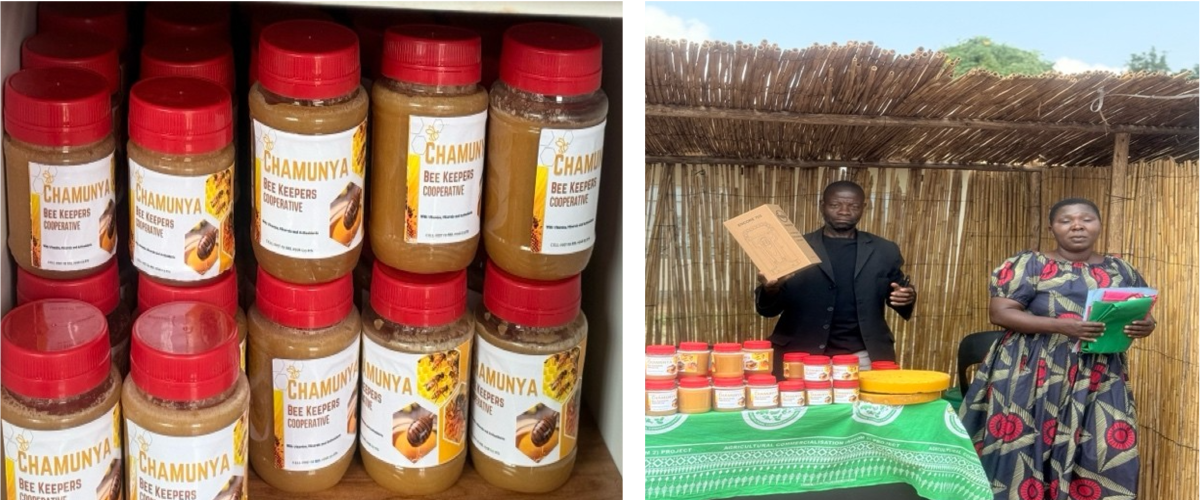
According to Ndhlovu, the cooperative has taken its success to different forums such as the District Agriculture Fair. This year, for the first time, the cooperative showcased its products at the Mzimba North District Agriculture Fair, and walked away with recognition and respect.
“It was a proud moment,” said Cooperative Secretary Mr. Nkhata. “We proved that rural farmers can produce premium quality honey that meet market standards, and we made valuable business connections.”
This success is a result of MFSRP’s sweet intervention in turning the cooperative to move from subsistence to commercial farming.
Through the MFSRP matching grant facility, the cooperative developed a honey commercialization business proposal valued at 119.9 million Malawi Kwacha ($69,173 US). MFSRP approved a 70% matching grant of 83.93 million Malawi Kwacha ($51,883 US), with the cooperative contributing 10% in cash and 20% in kind.
Before receiving the grant funds, members underwent extensive training in bookkeeping, cooperative management, procurement, environmental and social management, group dynamics, and sustainable beekeeping practices from MFSRP.
With the first tranche of the grant, the cooperative invested in modern equipment including hundreds of beehives, protective bee suits, smokers, honey extraction machines, and honey pressers.
They also drilled a borehole to ensure water availability for production. In addition, members received specialized training in modern honey harvesting, processing techniques, and sustainable management practices that protect natural habitats.
“We learned how to handle bees in a way that maximizes production while preserving the environment,” said Ndhlovu. “It’s not just about honey, it’s about long-term sustainability.”
The cooperative also gained the skills to negotiate with buyers, enabling them to secure stable contracts at higher prices.
The sweet results from MFSRP support are now visible. The change has been transformational. Production has more than quadrupled, the quality of honey now meets premium standards, and the price per kilogram has risen sharply. Farmers have moved from struggling to make ends meet to enjoying reliable, increased incomes.
“Before MFSRP, we were selling honey at low prices but now we have the capacity to supply larger orders with better prices without compromising quality,” said Nkhata.
For many members, this means they can send children to school, invest in their homes, and reinvest in their farming activities.
Looking into the future, the cooperative farmers see brighter light, and the sky is now the limit. MFSRP has given them a push and the cooperative is on its way to becoming an independent business.
Although the journey is far from over, with the second tranche of the grant, the cooperative plans to build a modern processing and packaging facility to add value to their honey, increase production to over 15,000 kilograms a year, and tap into new domestic and regional markets.
They also hope to share their expertise with other farmer groups to spread sustainable beekeeping practices across Malawi. “Our vision is to be Malawi’s leading honey producer known for quality, sustainability, and empowering rural farmers,” Ndhlovu said, adding that with MFSRP’s matching grant support, that dream is no longer far away.
From hive to harvest, Euthini (Chamunya) Bee Keepers Cooperative is proving that with the right support, rural farmers can produce world-class products, earn better income, and inspire entire communities. For donors, policy makers, and development partners, this is not just a sweet story, it’s a clear return on investment in Malawi’s agricultural transformation through MFSRP.