
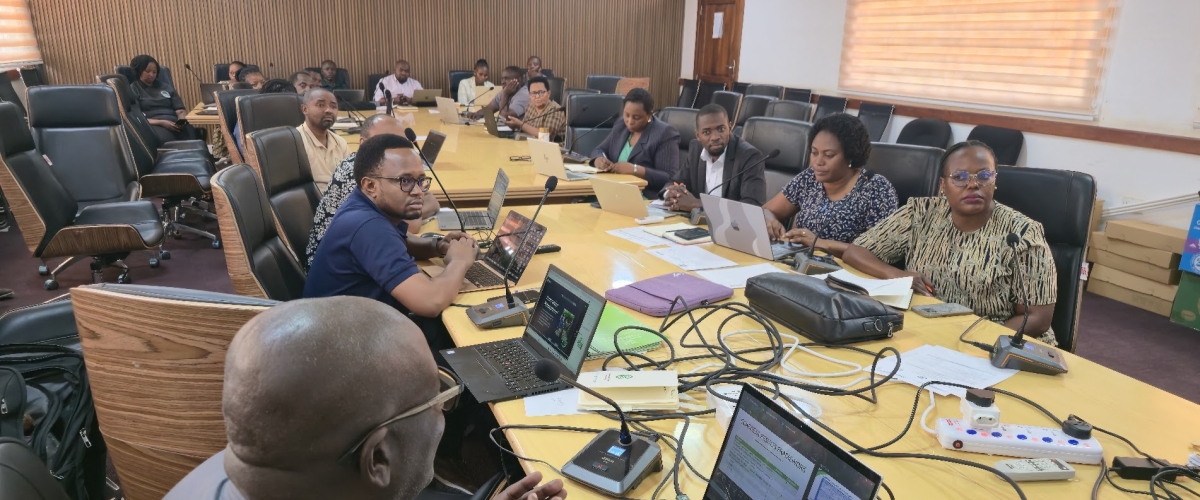
Building on the momentum of the Malawi consultation held on 11 September 2025, Tanzania convened its national consultation on 3 October 2025 in Dodoma to advance the implementation of the Tanzania Food Systems Resilience Programme (TFSRP). The meeting, facilitated by the Centre for Coordination of Agricultural Research and Development for Southern Africa (CCARDESA), brought together key stakeholders from the Ministry of Agriculture (MOA), the National Irrigation Commission (NIRC), the Tanzania Official Seed Certification Institute (TOSCI), the Agricultural Seed Agency (ASA), the Tanzania Agriculture Research Institute (TARI), and other national implementing partners.
The session was led by Mr. Timotheo Semuguruka, the TFSRP Country Programme Coordinator, and provided a platform to deepen understanding of the World Bank’s Environmental and Social Safeguard Framework (ESS10), strengthen inter-institutional collaboration, and share experiences on implementing the Food Systems Resilience Programme in Tanzania.
Opening the session, Mr. Semuguruka welcomed participants and reaffirmed Tanzania’s commitment to advancing the FSRP’s objectives of building resilient, inclusive, and sustainable food systems. He underscored the importance of collaboration to ensure that programme interventions are well-coordinated and aligned with national priorities. The Programme Coordinator further highlighted that Environmental and Social Safeguards are essential to the successful implementation of the project and the achievement of its intended outcomes. He urged those responsible for implementing the safeguards under TFSRP to adhere strictly to established standards and to effectively integrate them across all programme activities.
Mr. Dagmore Tawonezvi, CCARDESA’s Monitoring and Evaluation Officer, outlined CCARDESA’s regional coordination role under the FSRP, highlighting the value of multi-country learning in addressing shared challenges such as climate shocks, productivity gaps, and food insecurity. He noted that regional collaboration fosters collective progress and knowledge exchange across participating countries.
CCARDESA’s Environmental and Social Safeguards Officer, Mrs. Mirjam Taapopi, delivered an insightful presentation on the Grievance Redress Mechanism (GRM), emphasizing transparency, inclusivity, and accountability as essential elements of effective programme governance. She reminded participants that an absence of reported grievances does not necessarily signal satisfaction but could reflect limited awareness or accessibility of reporting channels. Her presentation also drew attention to the need for proactive measures to prevent Sexual Exploitation, Abuse, and Harassment (SEA/SH), stressing that strong institutional safeguards are vital to protecting the integrity and wellbeing of all programme stakeholders.
The Tanzanian team shared experiences from the rollout of the national Grievance Redress Mechanism (GRM), acknowledging progress while identifying key areas for improvement. Participants underscored the importance of continuous awareness creation, improved communication across institutions, and accessible reporting mechanisms to strengthen community trust and participation. The TFSRP reaffirmed its commitment to adopting and implementing the regional Code of Conduct to promote ethical practices and ensure accountability throughout programme activities.
The consultation concluded with a renewed sense of partnership and shared responsibility. Participants expressed appreciation for CCARDESA’s facilitation and technical guidance, noting that the session deepened their understanding of safeguards mechanisms and enhanced coordination among national institutions. The meeting reaffirmed Tanzania’s commitment to fostering a resilient and accountable food system that aligns with regional goals under the FSRP framework.